How much does voiceover cost in 2026?(rates, what drives them, and what to expect)
Professional voiceover for a 60-second commercial runs $150–$500 on most platforms. A finished hour of e-learning narration runs $250–$500. A 30-second podcast ad sits somewhere between $100 and $300.
Those ranges are wide — but the spread exists for real reasons. This post breaks down what drives voiceover pricing, what you actually get at each tier, and how to avoid paying more than you need to.
voiceover pricing at a glance
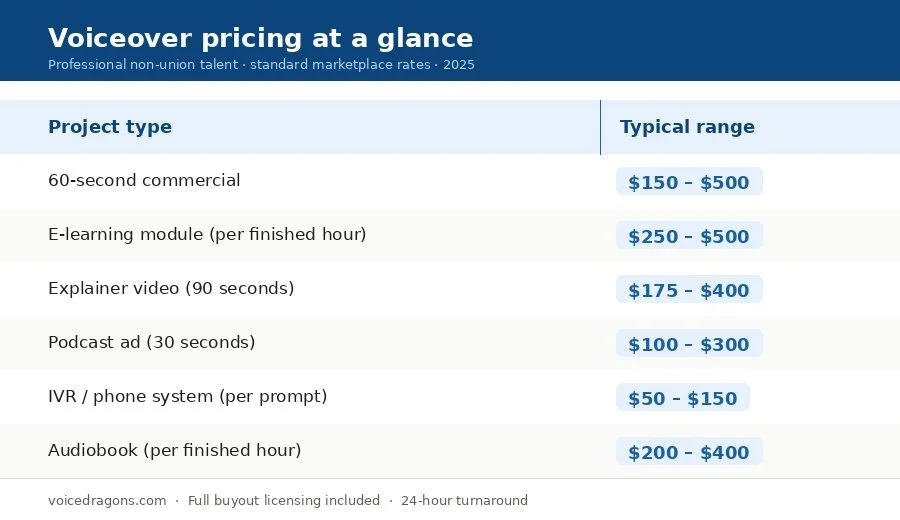
These are marketplace and platform rates for non-union talent with standard usage rights. Broadcast union rates (SAG-AFTRA) and celebrity talent run significantly higher and aren't what most marketing teams are buying. Character, animation, and video game work is priced a little differently, and what a character voice actor costs is covered separately.
What actually drives the price
Experience tier
A voice actor with ten years of commercial work and a broadcast reel charges more than someone who started last year. Both might sound good on a demo — but the experienced talent delivers on the first take, hits tone on brief, and doesn't need hand-holding. That speed has value when you're on a deadline.
Usage rights
This is the one most buyers miss. Some platforms quote a low session fee and then charge separately for usage — meaning you pay again when your ad runs nationally, or when you renew your campaign. Full buyout licensing means one price, no surprises, no rights tracking. If your platform doesn't specify buyout in the quote, ask.
Turnaround
Standard delivery on most platforms is 3–5 business days. Rush delivery (24 hours or same day) costs more — typically 25–50% on top of the base rate. If you're always working on a tight timeline, find a platform where fast turnaround is the default, not an upsell.
Union vs non-union
SAG-AFTRA union rates are set by contract and non-negotiable. For national broadcast spots they can run $800–$2,000 for a single 60-second commercial. Most online video, e-learning, and digital advertising doesn't require union talent — and non-union voices at the professional tier are indistinguishable in quality.
Revisions
Some platforms include one or two rounds. Others charge per revision. If your script tends to change after recording, factor this in. A $175 quote with $75-per-revision fees gets expensive fast.
Three ways to hire voiceover — and what each costs you
Freelancer platforms (Fiverr, Upwork)
You can find voiceover on Fiverr starting around $20–$30 for a short read. Some of those are genuinely decent. Most aren't. The bigger issue: quality is inconsistent, ownership rights are often vague, and there's no real vetting. You might get a great result on the first try. You might spend two weeks on revisions. For low-stakes internal content, fine. For anything that represents your brand publicly, the risk isn't worth the savings.
Large talent marketplaces (Voices.com, Voice123)
These platforms have large rosters of vetted professional talent. The quality floor is higher. But the model is built around auditions — you post a job, wait for submissions, pick one, then negotiate. That process takes days, sometimes a week or more. Voices.com also requires a subscription to access full features. If you need voiceover regularly and have time to run auditions, these work. If you need something now, they don't.
Curated marketplaces with flat pricing
Fewer choices, but the tradeoffs are different. Smaller vetted rosters mean less sorting. Flat pricing means no negotiating. Full buyout licensing means no rights headaches. Turnaround is typically 24 hours. You pay more per project than Fiverr but less time overall, and you know exactly what you're getting before you start.
Hidden costs to watch for

Usage rights surprises. Already mentioned above, but worth repeating because it catches buyers off guard. Always confirm whether the quoted price includes full buyout or just a session fee.
Revision fees. Ask what's included before you book, not after the first take.
Script prep time. If you don't have a finished script, budget time (or money) for that separately. A voice actor can record what you give them — they can't fix an unfinished brief.
Audition time. On platforms that use the audition model, the time you spend reviewing submissions is real work. If your team is small, that hidden labor cost adds up across multiple projects.
Turnaround mismatch. Booking a platform with 5-day standard turnaround when you routinely need 24-hour delivery means you're always paying rush fees. Worth solving structurally rather than project by project. If you're hiring for the first time, it also helps to know the warning signs that a low quote will cost more in the end.
When AI voice makes sense
AI voice has gotten good enough that for certain use cases, it's the right call.
Use AI voice for: internal presentations, rapid content prototyping, high-volume low-stakes explainers, content where you'll be updating the script frequently.
Use a human for: anything that runs publicly, anything requiring genuine emotional tone, brand campaigns, podcast ads where listener trust matters, and anything where you need full commercial usage rights without licensing complexity.
The choice doesn't have to be permanent. Some projects start with AI voice for speed and swap to human talent for the final version.
What $150 vs $400 actually gets you
At $150–$200 you're typically looking at newer talent — technically competent, good mic, but fewer years of commercial work. For explainer videos and e-learning where tone is neutral and delivery is clear, this tier works well.
At $300–$400 you're getting experienced commercial talent. These are people who have read for national brands, understand pacing and emphasis without being directed, and deliver studio-quality audio on the first take. For ad creative, product launches, and anything that runs in front of a broad audience, the extra $150 is usually worth it.
The mistake buyers make is optimizing purely for the per-project price. A $200 recording that takes three rounds of revisions and still isn't quite right ends up costing more than a $380 recording that's done. If you're working with a defined budget, here's a closer look at what professional voice talent costs on a small budget and where the hidden costs tend to show up.
What to expect when you're ready to book
The booking process should be simple: pick a voice, submit your script, confirm delivery date. If a platform requires you to post a job, wait for auditions, negotiate a rate, and manage usage rights separately — that's friction built into the model, not a feature.
Look for flat pricing, full buyout licensing included, and a clear turnaround window before you commit. Those three things eliminate most of the surprises.
Voice Dragons offers professional voiceover with full buyout licensing and 24-hour turnaround. Flat rates, vetted talent, no subscriptions.